



Gran Canaria Road Trip: 7 Stops and One Hidden Gem
A Gran Canaria road trip isn’t optional if you actually want to see the island. The resort coast is one small slice of it; everything that makes Gran Canaria genuinely remarkable sits inland, uphill, or along a coastline the coaches never reach.
A car is what turns a beach holiday into an island one: dunes, volcanic peaks, and an old colonial capital, all reachable within a couple of hours of each other.

START/END
Las Palmas de Gran Canaria
DISTANCE
Around 180 km (110 miles) for the full loop, less if you skip the detour to El Puertillo
DURATION
5 to 6 days, enough time to actually stop at each place rather than just drive past it
ROAD CONDITIONS
Coastal motorways are fast and well maintained, toll-free the whole way round. The interior climb toward Tejeda and Roque Nublo narrows into genuine mountain switchbacks; take them slowly, especially if cloud rolls in.
THE BEST TIME TO GO
Year-round works, but February is worth planning around specifically; that’s when the almond blossom around Tejeda peaks. Spring and autumn avoid both winter cloud at altitude and the busiest summer weeks on the southern coast.
BOOKING THE CAR
I always book through DiscoverCars, where every car is rated between 5 and 10 stars purely on completed rentals rather than open reviews. I filter above 8 stars to shortlist the most trusted operators and add full coverage at booking, around €10 a day.I always book the car very well in advance, and if plans change I just cancel (free up to 48 hours before pickup)
The general licence, age, and fuel rules across the archipelago are the same ones I cover in my Canary Islands driving guide, worth a quick read if this is your first island rental here.

Firgas
Firgas is best known for its mineral water, and most people drive straight past it without stopping. That’s the mistake.
Walk up to the town centre, and you’ll find the Paseo de Canarias, a long staircase-promenade entirely covered in hand-painted mosaic tiles. Each of the eight Canary Islands is mapped out in full detail – coastlines, towns, landscapes, a ceramic atlas built into a public street.
Fifteen minutes is enough to see it properly, and it’s one of the least touristy stops on this whole route.

Arucas
A short drive northwest, Arucas is dominated by a church everyone calls a cathedral even though it officially isn’t one. San Juan Bautista is neo-Gothic, built from dark local basalt starting in 1909.
It wasn’t considered finished until 1977, and the result looks convincingly medieval for a building that’s entirely 20th century, dominating a town this size the way an actual cathedral would.

Hidden Gem: El Puertillo
Just north of Arucas on the coast, a small cove most visitors never hear about. Natural rock pools carved into volcanic rock, calm, sheltered, and completely free.
Local families have used it for generations, and it sits in total contrast to the polished beach infrastructure further south.
No sunbeds, no entry fee, just rock and water.

Vegueta, Las Palmas
Head into the capital, specifically into Vegueta, the old quarter most visitors to the island never actually reach. Las Palmas was founded here by the Spanish in 1478, one of the oldest colonial settlements in the Atlantic.
The Cathedral of Santa Ana anchors the main square, begun in the late 15th century under the Catholic Monarchs. Nearby, the Casa de Colón marks where Christopher Columbus reportedly stayed during an Atlantic crossing.
In the same square stands a seated statue of Benito Pérez Galdós, born in this neighbourhood in 1843 and generally considered Spain’s most important novelist after Cervantes. Forty-six novels, a Nobel nomination in 1912, and still barely known outside Spain.

Puerto de Mogán
Southwest to the town every brochure insists on calling the Little Venice of Gran Canaria. There’s one small water channel, and the resemblance ends roughly there.
Whitewashed houses buried in bougainvillaea, a harbour full of colourful fishing boats, and a calm, sheltered beach that’s genuinely one of the better ones in the south.
There are a few genuinely great places to stay on Gran Canaria depending on which coast pulls you, and Puerto de Mogán is a strong pick if the west side is on your route. A few nights here play out very differently from the main resort belt further east.
Maspalomas Dunes and Lighthouse
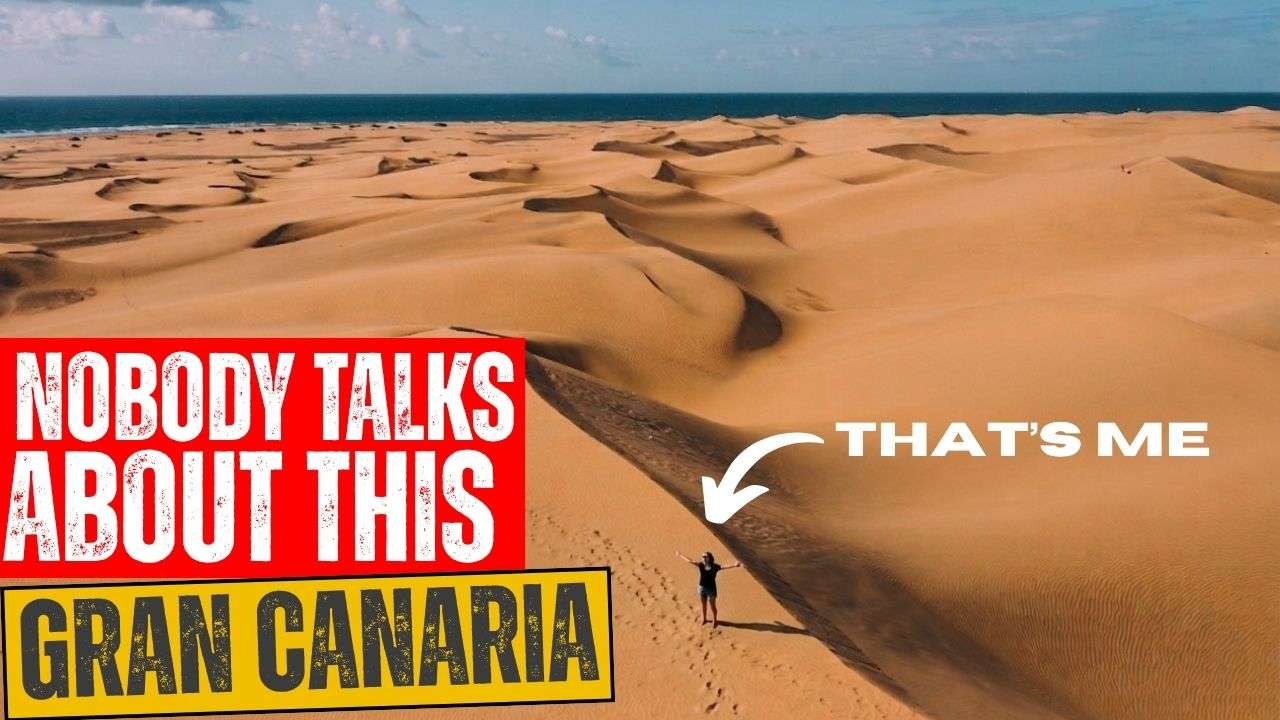
East along the south coast, the mountains give way abruptly to something closer to the Sahara. The Maspalomas Dunes cover over 400 protected hectares, golden sand rolling straight toward the sea.
Walk in far enough, and the hotels vanish almost immediately, just wind, sand, and real scale. The Faro de Maspalomas at the tip took nearly 30 years to complete after being proposed in 1861; the site was so remote a jetty had to go in first just to land the stone.
A previous experience of a car rental in Spain definitely helps; however, there are a few key differences between mainland and this remote island, tolls being the first one. For suppliers specifically on this island, I’ve ranked my top picks for Gran Canaria separately.
Tejeda
Inland and up, Tejeda regularly gets named one of the most beautiful villages in Spain, sitting inside an ancient volcanic caldera above 1,000 metres. Every February the surrounding valley turns white with almond blossom.
The village is small and whitewashed, with cobbled lanes lined with almond sweets and almond ice cream. Walk to the edge and look southeast toward where the trip is heading next.
If Tenerife is part of the same island-hopping trip, the same slow, north-to-south logic works there too; I’ve mapped out a full road trip by car along with my preferred suppliers in Tenerife sorted by airport.

Roque Nublo
The finale, and the island’s true centre, an 80-metre volcanic monolith rising from a plateau at 1,813 metres, visible from almost anywhere on Gran Canaria on a clear day. The Guanches treated the site as sacred long before the Spanish arrived.
The walk up from the La Goleta car park runs about 1.5 km through Canary pine forest before the tree line breaks and the terrain turns bare and almost lunar. Allow 45 minutes up, 30 back down.
Dress in layers; conditions at this altitude shift fast, often 10 degrees colder than the coast. On a clear day, you can pick out Mount Teide on Tenerife from the summit, over 100 km away, which is about as good a closing view as this island offers.


Leave a Reply