



Driving in Croatia: What to Know Before You Rent a Car
Croatia has over a thousand islands, a coastline that narrows to single-lane villages in places, and a rental market that behaves differently depending on which of its airports you land at.
Most of what goes wrong here isn’t really about the car; it’s about not knowing the local quirks until you’re already standing at the desk.
Here’s what I’d actually flag before you book.

The Mistakes and Scams First
Undocumented pre-existing damage is the big one. A lower-rated local operator hands over a car with a scratch or dent nobody pointed out, and at drop-off it’s suddenly your bill.
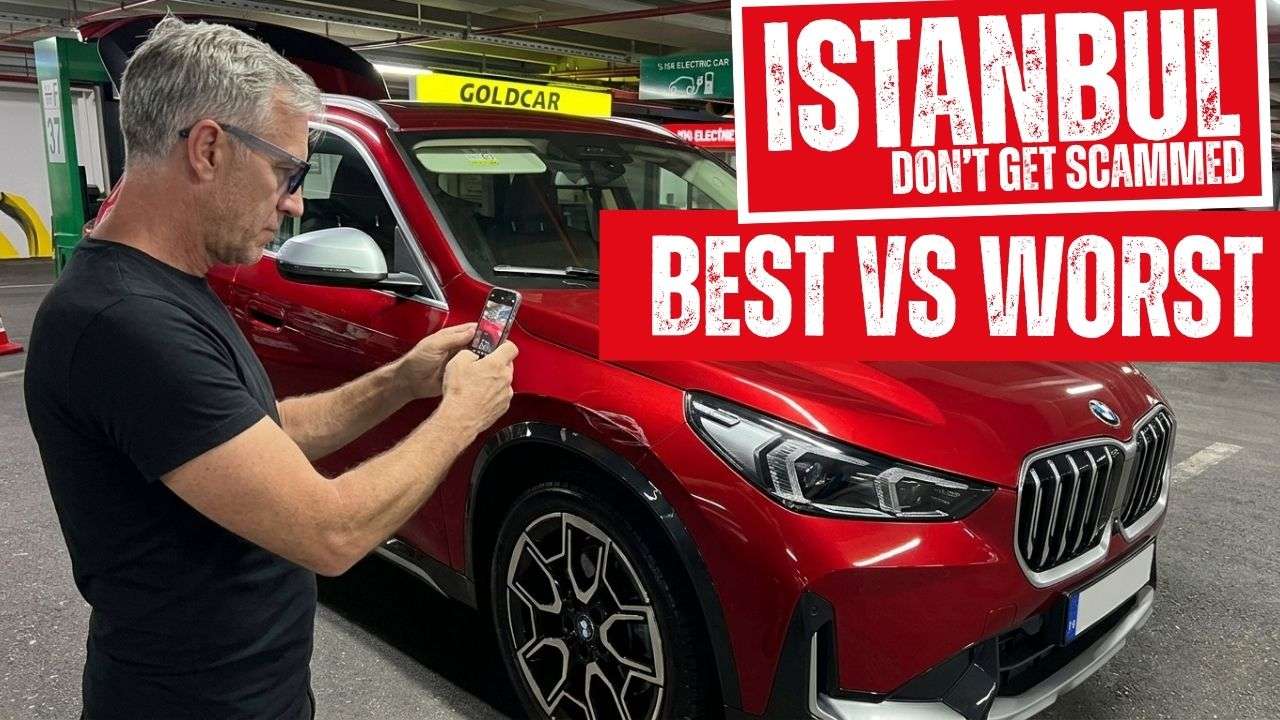
Photograph every side, the roof, the undercarriage, the wheels, and the interior before you drive off, then do it again at return for full before/after documentation; five minutes of photos against a dispute you don’t want.
The second trick shows up if you’ve already bought full coverage through a third-party insurance or comparative site: the desk agent insists it isn’t valid and tries to sell you their own policy at a huge markup.
Your pre-bought full coverage is valid. Stay calm, show the booking confirmation, and call the platform’s support line from the counter if they push back; most agents back off the moment you even try to make the call.
Third, watch the fuel policy. Full-to-full, collect full and return full, is the fair standard here. Some operators push full-to-empty instead, charging you upfront for a full tank at an inflated rate and expecting you to run it dry, which you never do exactly, so you end up donating fuel back to them on top of the markup.
Zagreb, Split, or Dubrovnik: Where You Land Changes the Price
Croatia has eight international airports, but Zagreb, Split, and Dubrovnik are the three that matter for most itineraries, and Dubrovnik is consistently one of the priciest rental markets in Europe during peak season. The same car class can genuinely cost double what it does in Split.
If your route allows it, flying into Split and driving south down the D8 coastal road is often the better call financially, and I’ve ranked my actual picks for car hire in Split separately if that’s your plan.
For itineraries that end in the south, my Dubrovnik supplier picks cover what to expect there specifically.
One-way drop-offs between cities, Zagreb to Dubrovnik being the classic example, typically add €300 to €400 or more on top, sometimes as a flat fee, sometimes folded into a higher daily rate. Price that in before you commit to the route, not after. In most cases, it’s honestly much more convenient to just go back to the same airport you picked up your car.
Book in Advance
Ask anyone who’s turned up in Split or Dubrovnik in mid-August without a reservation, and you’ll hear some version of the same story: nothing left at the counter, or only the car nobody else wanted, at whatever price the last operator standing feels like charging.
Croatia’s coastal fleet simply isn’t sized for how many people all want a car during the same six or seven weeks. The shortage is really a supply problem more than a demand one.
Zagreb, Split, and Dubrovnik between them have dozens of small and mid-sized local operators, none large enough on its own to absorb the summer surge, so the good cars at fair rates get picked off first, sometimes months before the season even starts, leaving latecomers choosing between overpriced leftovers.
This is exactly why I always book well in advance on my favourite comparison website called DiscoverCars, which pulls every one of those scattered local and international suppliers into a single search, so I compare the whole market at once rather than whichever two or three companies happen to rank highest on a search engine.
Every listing carries a rating from 5 to 10 stars based only on completed rentals, not like Google Maps where everyone can add a review. I filter above 8 to shortlist only the most trusted operators before even looking at price.
Because cancellation is free up to 48 hours before pickup, there’s no reason to wait and see how prices move. I lock in something reasonable as soon as I spot it, and if a better car or a lower rate shows up later, I just cancel and rebook. In Croatia’s summer market, the risk sits entirely with waiting, not with committing early.
Manual Is the Default, Automatic Is an Upcharge
Most of the fleet here is manual, and Dalmatian coastal roads reward the smaller car that comes with it, narrow, winding, occasionally down to one lane when a tour bus meets you on a blind corner. Island roads are tighter again. Stick to a compact for anything coastal or urban.
Automatics exist but are genuinely scarce; expect to pay roughly €15 to €20 more a day for one simply because demand outstrips supply. If you can drive stick, you’ll have a wider choice of cars and a smaller bill.
Getting a Car Onto a Ferry, Local or International
With this many islands, ferries are part of the deal, but taking a rental car onto one involves more paperwork than you’d expect. Declare it when you book; most companies allow their cars on domestic routes to Hvar, Brač, Korčula, or Krk, but they may charge an island fee, typically €15 to €50.
International ferries, to Italy or elsewhere, are a different matter entirely, not permitted unless your contract explicitly says so, and usually with an extra cross-country fee north of €50 when it is.
Book your ferry slot as early as you’d book accommodation. In July and August, Jadrolinija, the main operator, sells out car spaces weeks ahead, and turning up hoping to drive onto the next sailing from Split is optimistic at best.
I’ve mapped a full route around this timing in a Croatia road trip itinerary if you want the sailing logistics built in from the start. If you’re island-hopping heavily, it’s often simpler to travel as a foot passenger and rent something small locally on each island instead.
Licence Rules and the IDP Question
EU and UK licences work as-is here, no extra paperwork. Outside that, you need an international driving permit carried alongside your original licence, not instead of it, and while some desks won’t check for it at pickup, its absence can void an insurance claim if you’re ever stopped or in an accident.
Age requirements are firm too, most companies want drivers at least 21 with two years on their licence, and anyone under 25 typically faces a young-driver surcharge of €7 to €10 a day.

The Give-Way Rule That Catches People Out
Croatia drives on the right, seatbelts are mandatory front and rear, and the blood-alcohol limit sits at 0.05%, effectively zero for newer drivers, enforced with genuinely common roadside breath tests in summer.
The rule that actually surprises foreign drivers most: on smaller roads without signage, whoever’s approaching from the right has priority, not whoever’s on the wider-looking road. It comes up constantly in villages and on island lanes. HAK, the Croatian Automobile Club, publishes the country’s official rules if you want the source directly.
Every car is also legally required to carry a reflective vest, warning triangle, and first aid kit; check the boot before you leave the lot rather than assuming it’s there.

The Bosnia Corridor and the Bridge That Fixed It
The coastal drive between Split and Dubrovnik used to pass through a short stretch of Bosnia and Herzegovina around Neum, a genuine border crossing mid-trip. Most rental agreements cover this transit, and your Green Card insurance extends to it, but it’s worth confirming at booking rather than assuming.
Since July 2022, the Pelješac Bridge, a 2.4 km span, lets you skip the Neum corridor entirely and stay on Croatian territory the whole way, no border stop, no paperwork. Worth routing over deliberately if you’d rather avoid the crossing altogether.

Parking: Colour Codes and Where It Gets Genuinely Hard
Dubrovnik’s Old Town is fully pedestrianised; park in one of the lots outside the walls, the cable car car park doubles as a decent viewpoint while you’re at it. Split’s centre works the same way: park near the harbour and walk in rather than hunting for a spot inside.
Blue zones mean paid parking, white is generally free or time-limited, yellow means don’t. Fines run €30 to €100, and some companies tack an admin fee on top when they process it; pay promptly, and that extra charge often disappears.
Away from the big three cities, parking on the islands and smaller coastal towns is refreshingly easy, usually free and a short walk from the beach.
Extending the Trip Into Montenegro or Albania
If Croatia is only part of a longer route, plenty of travellers continue south into Montenegro or Albania, and it’s worth planning the rental around that from the start rather than discovering the restriction at the border.
Not every company allows it, and where it is allowed, expect to buy a Green Card insurance extension, typically from around €35, plus a separate cross-border fee that can run anywhere from €10 to €50 depending on the supplier and destination.
Declare it when you book rather than at the counter; it’s consistently cheaper and avoids a last-minute scramble.
If a longer multi-country loop is what you’re actually planning, I’ve put together a broader guide to building a 10-day road trip across Europe that covers this kind of border-hopping itinerary in more depth.
Final Thoughts
Book early for summer, pick your airport based on total cost rather than the cheapest flight, photograph the car at both ends of the rental, and sort your ferry and border logistics before you land rather than at the counter. Get those right and the drive from Split down to Dubrovnik, or out to whichever island catches your eye, becomes exactly the trip Croatia’s coastline promises.




Leave a Reply